Wednesday, July 05, 2006

Art For Society's Sake

Bhagna Astha Ko Khandhar: An Anthology of Short Stories by Vijaya Chalise, Published by Sangrila Prakashan, Kathmandu, Price: Not mentioned, Pages 10+106.

-By Gopi Sapkota

It is good to know that we still have writers who along with getting satisfaction from writing, try to correct the wrongdoers by their pen. However, it is an irony that these write-ups are hardly read.

It is a known fact that we can not have an utopian society except wishing for that. But again, we can no longer be satisfied with the system of life we are condemned to live. When pains of dissatisfaction grow mature writers can no longer remain silent. So has Bijaya Chalise done in his newly released anthology of short stories entitled 'Bhagna Astha Ko Khandhar'.

The book has a lot to say. It has a lot to share. And they are nothing new but the problems we have been facing. It seems Chalise, an already established writer and journalist, has a purpose in his writing like that of Mathew Arnold who propounded the idea of art for the sake of society. Chalise coincides his feelings and experiences of this mundane society with that of general people and thus orients the readers towards their feelings and experiences.

The book, with a total of 18 short stories in it, portrays a true picture of the contemporary Nepalese society. It’s a pure reflection of existing social and political anomalies and aberrations. The stories in the anthology not only inform but also leave an impression of a mundane society in which we are condemned to survive with a sigh of dissatisfaction.

The first story of the collection ‘Yug Yugki Janaki’ talks about a mythical character to portray the state of women. The story is about Sita, a mythical character of the epic Ramayana. It X-rays the mental agony of Sita when she was being imprisoned by Ravana, the demon king. Sita remembers the incident when the demon king's sister, Surpanakha, had proposed Ram, Sita's husband to marry her when they were on 14-year exile. Ram and his brother Laxman had cut off the nose and ears of Suparnakha because she had taken Sita as her rival. By then, Ram’s dedication towards her had made her feel an immense sense of happiness. But now, she realises that Surpanakha was also a woman and the case of Surpanakha at that time was similar to hers.

In this story, the author has projected the feministic approach to look at the society. The story articulates the existence of women in the society from the very beginning. The society has treated women as a ‘thing’ and not as a human being. Each woman in the society, whether she is Sita or Surpanakha, is like an object. Women are compelled to accept the physical and mental torture created by men. Both Sita and Surpanakha are women, and are the victims of men.

Paru, another story of this anthology, has to talk about how traditional our society is. The story is about caste discrimination. Paru, the main figure of the story, belongs to so called untouchables. Hari, a man from upper caste society, falls in love with her. Since Hari pertains to superior level of society, his so called relatives become barrier to their love.

The story is written on flash back technique and the plot is very strong. This is the reality of women in the Nepalese society. Most of the people in the village are bound to face this situation. It is because they can neither speak against so called cultural values nor can go against them.

Another story "Harke Kehi Bujdaina" (Harke doesn’t understand anything) again is a big satire against the functionings of the government and bureaucracy and their biasness for the rich only. The story speaks for the poors and suggests the policy makers to think of poors before making plans and decisions.

The title story, meanwhile, talks about how truth, intelligence, responsibilities, peace and faith have disappeared and falsehood has ruled the society.

Many of Chalise’s stories like 'Nirdosh Prasna' (An Innocent Question), 'Sampurna Kranti' (A Complete Movement), 'Charkeko Ghar' (Wrecked House) etc. can be studied from Marxist point of view. For Marxism, society is everything and art should be for the society and it should be able to direct it. Chalise’s choice is society. The subject matter on which he writes is about society and the purpose he writes is to bring change in it.

His stories also talk about movements and police tortures. They also speak about corruption and other social injustices. Portraying the present day human miseries, the author aims to generate awareness regarding social absurdities. By creating awareness on those social absurdities, he tries to make people to get up from a sleep of Rip Van Winkle and fight against existing social maladies.

Furthermore, Chalise's stories exhibit the injustices subsisted in the society and the partiality. However, there is no diversity of thought in his stories. Many stories serve the same taste to the readers--the conflict between two classes. Having depicted the minor aspects of events in a lucid but effective manner Chalise has revealed his expert hand.

The language used in his short stories is very simple and lucid. This may be because of his journalistic background. Chalise a journalist by profession and a novelist, essayist and a storywriter by career also writes for the Children as well. He has already written six books on different genres like novel, essay, short story and six more books on children’s literature. Altogether 13 books of Chalise, including the present one, have been published so far.

Interaction on collection of plays

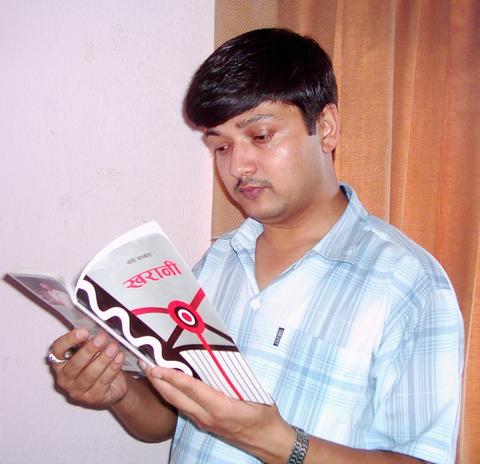
KATHMANDU: The Nepali Writers’ Association organised an interaction programme on a newly published collection of plays ‘Kharani’ (Ashes) of experimental dramatist Gopi Sapkota.

Speaking at the function, academician Sanat Regmi said the plays have broken the trend of contemporary Nepalese drama. "The style and thought of plays is unique, which has established Sapkota as a young dramatist of Nepal."

Senior litterateur Dr. Dhruba Chandra Gautam said the plays have stood at the mid-point of existential and absurd philosophy. "Any piece of writing cannot absolutely be of one single philosophy, rather it borrows the diverse thought from different philosophies," he said.

While critic Laxman Prasad Gauatum remarked that Sapkota’s plays were more close to absurd school of thought than existential one, storywriter and critic Rosan Thapa ‘Nirav’ said the drama Kharani has depicted the current uncertainties and present absurd situation, which compels one to think about the existence.

Speaking from the chair, poet Dr. Khum Narayan Paudel, the president of Nepali Writers’ Association said, "Sapkota’s plays present the intellectual loneliness of contemporary society". He further appreciated bringing new scientific technologies in dramas

Friday, February 03, 2006

Durga Bhandari and his Poem 'Aryaghat'

Durga Bhandari and his Poem 'Aryaghat'

Durga Prasad Bhandari, in his poem Aryaghat, talks about death. A highly matured sense of the external and internal fire has been demonstrated in the poem. Desire is more terrible fire than the actual fire that burns dead body. Poet Bhandari mediates upon the fire and desire. The death of human body is the death of desire. Those dying (still alive) have been suffering from the desire. The dead bodies have to die no more, as they have already dead, and they are burnt with fire. Along with the burning of human body, their desires too turn into ashes. They transform into the death-free and desire-free creatures. However, the living human beings have to suffer, as their desire has not been burnt. Hence, Bhandari stressed that dying – the process to die – is more tortuous than to be dead at all.

Upon the theatre of Aryaghat
Dead bodies have gone beyond death and desire
Dying bodies are here to suffer the fire of desire
And desire is a more terrible fire
Than the fire of the burning ghat. (Aryaghat)

Poem by Dr. Shreedhar Prasad Lohani

Passage

By Dr. Shreedhar Prasad Lohani

The night split by light
Surged back with brutal force;
A blue sheet intermittently
Revealed an ancient tower-
Dracula came back alive;
In the orange flash
The howl was monotonous;
Trough the iron bars
The blackness crept back and forth
And I watched bewitched with vacuity.

The dawn in gray
Passive and static
Revealed a concrete structure
With TV antennas jutting out in space;
A sparrow perched
On the high tension line
For a minute and then flew away;
A pile of blue hills stood somberly;
Dracula died once more
And I watched disillusioned with vacuity.

Wednesday, July 13, 2005

Poem by Dr. Vinay Jha

Dreamy Savior
By Dr. Vinay Jha

My dreams and me
My slumberous visions and my diurnal life
Have a link as firm as rock
As true as wings and flights.

I see my dreams, wafting through to me
Not from the webby, bony cellar of my mind
They, I feel come to bless me
From the One who pities
My multiple handicaps: both innate and imposed.

My dreams, my visions are never empty
They bring me light when I am almost blind
They bring me meanings when I am confusion personified
They bring me breath into my frozen body
And help me resume my journey destined.

O, so sad, so unfortunate
For between visits of my airy friends
My dreamy guides
I always pass,
Through pricks and glooms
Through thorns and thins.

Gradually, glooms and thins, thins and glooms
Ride on me, lash on me until my bones
Come out of my flesh,
I lie down, left out, dumped
And then just before
I am all done down
They come with balm and blessings.
Lift me up, dress my wounds up.

And then I feel purged
Of my tormentors’ stains
My sloth, my emptiness, my crudity and the like
And all fresh from the dreamy treats
I proceed on, with my journey destined.

Friday, July 01, 2005

Khem Aryal's Kathmandu Saga And Other Poems

Kathmandu Saga And Other Poems, an anthology of thirty-five poems, is the debut book of Khem Aryal, an emerging poet of Nepal. Aryal started his writing career in 1990, when the whole country was fighting for democracy. After the millennium, poet Khem started writing in English and brought out the anthology in 2004. His poems deal with the theme of love and politics. Frustrations of present political failure have been presented very powerfully and artistically in his poems.

Mr. Aryal, who was born in Palpa, earned his Masters in English Literature from Tribhuvan University in 1997 and started teaching the following year. HE has been teaching creative writing at present and is also the president of Society of Nepali Writers in English.

Wednesday, June 29, 2005

Sabda Satabdi: the poetry of absurdity

Gopal Parajuli, a prominent writer of Nepal, always seeks for new dimension in writing to create his identity as an experimentalist. He loves to play with words, thoughts and feelings to experiment. He is fond of shaping new form in his latest writing. Sabda Satabdi (The Century of Word) is also an experimental work of art by Mr. Parajuli. Sabda Satabdi has been divided into two parts – Satabdi Purush and Sabda Purush. The Satabdi Purush, a man of century submits the proposal where as the Sabda Purush, the man of word inaugurates the proposal. These proposals are in the forms of poetry. There are 36 poems under the section Prastav Jaher (Submission of Proposal) in Satabdi Purush and 38 poems in Prastav Udghatan (Inauguration of proposal) that falls under the category of Sabda Purush.

The Satabdi Purush, the man of century has been talking about the current problems through the poems. The war lovers are attracting all towards their own thought in the country of Buddha. The truth is in emergency. The power holders are in love of war. The war has been waged for power. Though all the views advocated through the poems are of the poet Parajuli, he states his own view about his poetry in the foreword. He explicates – 'the world can’t be empty by murdering few people – those who stand against of peace should know clearly’. Poet Parujuli is a peace lover. He knows that the peace is in crisis at present. This situation haunts him. He composes-

The savers have started to tell lie
The enemies have started to conspire
Against the country. (Proposal 4)

'Time has already exited from the boundary of definition.' Poet Parajuli further talks in relation to time, space and poems. 'Poetry can’t go out from words, neither it can go out from life. It can’t go out from the emotions. It can’t go out from the expression of feelings. There is no space for poetry out of human being.' Gopal Parajuli believes that for poetry the existence of human beings is important.

The whole country has deepened in despair. People are eagerly waiting for the ray of hope. A continuous waiting for the fortune! We can clearly see the chauvinistic feelings of the poet overwhelming in his heart. He loves the people, the country. He writes:

People are waiting to listen
who brings the new news
for country?
(Proposal 4)

Science has been networking
violence and murder
through internet
through email
(Proposal 32)


The second part of the book is of Sabda Purush, the man of word. So, there is no need to worry with the submission of frustrating proposals, the man of word has powerfully come out with forceful inaugurations. The man of the word spells out -

To save the life,
I declared myself
as a first police of the life.
(Inauguration 1)

These voices show the hopes for resolving the problems. But these expressions seem funny. The stanza like declaring himself a first police to save his own life shows the people's attitudes of individuality. It may also reflect that if one is saving oneself means everybody is saving him/herself. So, there requires not the security forces. It's a perfect stage of life that Mr. Parajuli has dreamt of.

Gopal Parajuli always hopes for better. He expects the God, waits for Him. Though he himself does not know, whether the God exists or not, he wishes a friend who brings him the God in the world of love. Meanwhile he also suspects whether the enemies will come. But his desire of God's arrival seems strong. He states:

In my love
if the enemies do not come
a friend will come with the God .
(Inauguration 6)

Sometimes, the heart bursts out vigorously. The inner power becomes so strong that anything won't be impossible. The poet's expression:

I will seize the gun from present
and will change the scene
at least for a moment
(Inauguration 19)

Changing the scene for a moment is not enough as well as is not what the people have expected. If it is to be changed, it should be changed completely, that's what the poet has not expressed. So, these expressions seem absurd, in complete. May be he urges others to fill up what he has left as gaps?

The form of absurdity has been seen in the dramas in most of the cases, where as Gopal Parajuli utilizes the absurd form of writing not only in his dramas rather chooses to experiment in his poems and short stories. When the life and society are entangled confusingly in the abyss of absurdity, how a write can escape himself from the abyss, that compels him to express his opinions in absurd way. This is what poet Parajuli has been experiencing and expressing.

The divergence in subject matter and stylistic novelty reflect his originality in writing. His experimental nature always encourages him to exercise with the philosophies of existentialism and absurdity. Gopal Parajuli emphasizes more in the form rather than the content of his works of art. Searching, identifying and presenting ideas through new forms of expression has helped poet Parajuli glitter among the other nepali writers.